
作者:百年不渡 分类:未来幻想 点击:865次 下载:6801次 大小:70M 日期:2026-08-26
川师大杀人案
Russia's Ouster From WTO Would Jeopardize West & Global South's Development, Scholars Warn_我的网站

一 |
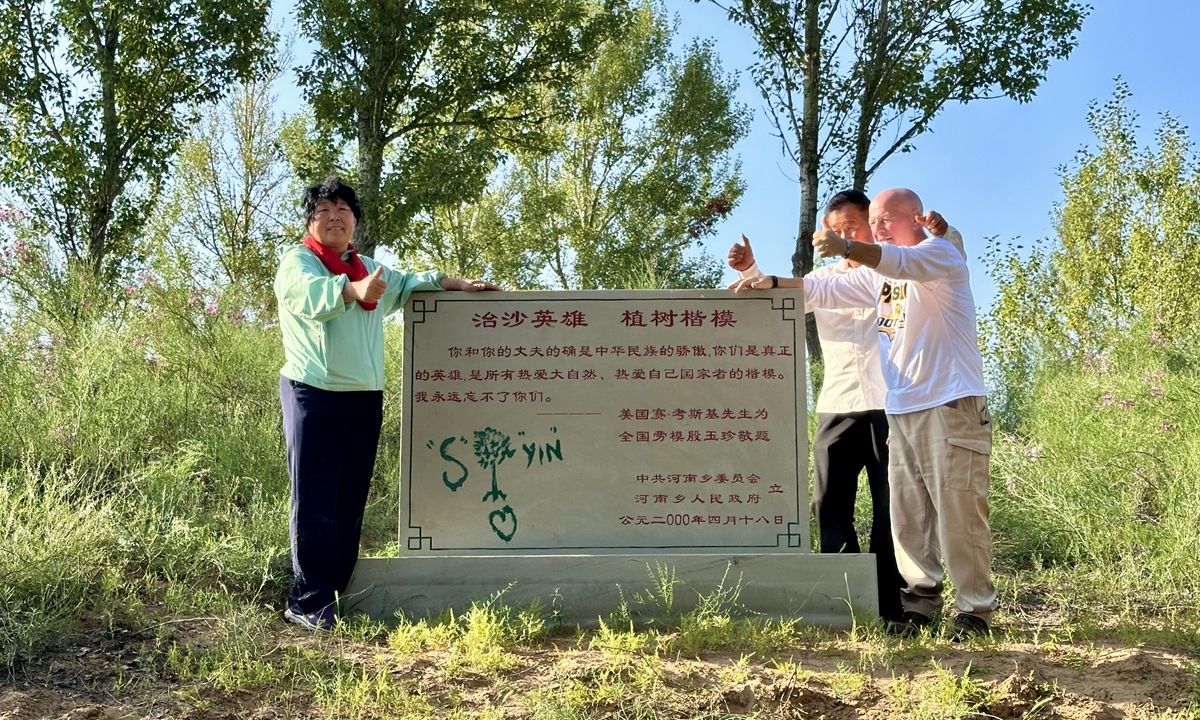
At the Ordos Ejin Horo International Airport in Ordos, North China’s Inner Mongolia Autonomous Region, Yin Yuzhen, a nationally recognized hero in desertification prevention and control and her US friend “Sai Kaosi” (whose real name is Ronald Sakolsky) embraced each other in tears.
This reunion after 26 years, spanning the Pacific Ocean, took place as scheduled under the witness of the lush greenery of the Maowusu Desert, touching the hearts of countless people around the world.
This reunion across mountains and seas was not only a long-awaited gathering of two old friends, but also a vivid testament to how goodwill can take root, how people can work together in desertification control, and how people to people friendship can endure.
This reunion was a beautiful echo of goodwill transcending time.
Twenty-seven years ago, Sakolsky, who was teaching in China, was deeply moved by the story of rural woman Yin’s efforts to combat desertification and curb the spread of sand. He selflessly donated $5,000 to support her efforts and traveled specially to the Maowusu Desert in Wushen Banner the following spring to visit and encourage her.
Yin kept this assistance firmly in her heart and repaid it by planting trees. As seasons came and went, 50,000 saplings, together with precious goodwill and trust, took root in the Maowusu Desert and grew into towering trees.
Yin’s repayment was not a return of material wealth, but the transformation of a profound goodwill that crossed national borders into patches of greenery deep in the desert through her day-after-day sweat and perseverance.
This reunion highlighted the tremendous power of people planting trees together until forests grow.
Yin’s life is a history of struggle against wind and sand. At the age of 19, she married into the Maowusu Desert, where wind and sand blocked her door overnight. The rural woman made the solemn vow, “I would rather die from exhaustion planting trees than let the sand overwhelm me.” She fought scorching heat and drought, battled strong winds and raging sand, and worked tirelessly for decades, eventually turning more than 70,000 mu (4 666.67 hectares) of desert into an oasis.
Sakolsky extended a helping hand and provided strong support because he was deeply moved by Yin’s desertification control efforts. Two ordinary people joined hands in tree planting and desert control because of their shared aspiration for greenery.
Countless ordinary people like them, carrying enthusiasm, keeping their feet on the ground and devoting themselves wholeheartedly, have gathered the great strength of many people planting trees until forests emerge, transforming landscapes and creating miracles in the world.
This reunion demonstrated the enduring contemporary value of people-to-people exchanges. A faded group photo, more than 20 years of never forgetting, a nationwide effort to search for someone, and a journey across the ocean to meet again – the friendship between Yin and Sakolsky is rooted in the recognition and respect between ordinary people, simple yet deeply moving. Friendship, which derives from close contact between the people, holds the key to sound state-to-state relations.
People from different countries have different cultural backgrounds, but they share the same love for the planet we call home, the same aspiration for lucid waters and lush mountains, the same pursuit of a better life, the same appreciation for every bit of goodwill, and the same cherishing of sincere friendship. Just as Yin carefully tended the saplings planted in the desert, nurturing this bond of affinity and understanding among people with sincerity will enable it to grow ever stronger and more resilient despite winds and sands.
This reunion provided a vivid example of “jointly building a community of life for man and nature.” For humanity to achieve better survival and development, it must carry out desertification prevention and control. Through a lifetime of arduous efforts, Yin brought about a green transformation in a corner of the Maowusu Desert, serving as a microcosm of China’s desertification prevention and control efforts.
As one of the countries most severely affected by desertification in the world, China has continued its efforts in desertification control for more than half a century, achieving a historic transformation from “sand advances, people retreat” to “green advances, sand retreats” with both desertified land and sandy land areas continuously decreasing.
As a foreign friend, Sakolsky, driven by the simple belief that “humanity has only one Earth, which is our common home, and we should all cherish it,” resolutely supported Yin’s desertification control efforts. Through his actions, he has shown us that protecting the ecological environment is a common cause of all humanity – by working together and supporting each other, humanity will surely be able to leave a clean and beautiful world for future generations.
Deep in the Maowusu Desert, plants and trees remain silent, yet they represent the most touching language through which humanity and nature, and humanity and the world, communicate with each other. This place is not only a shining answer sheet for China’s ecological civilization development, but also a warm example for global desertification control through extensive international exchanges and cooperation in jointly creating more greenery.
From $5,000 to 50,000 towering trees, from a landscape once covered by wind and sand to vast stretches of lush green, from the other side of the Pacific Ocean to the depths of the Maowusu Desert, the reunion between Yin and Sakolsky inspires us that goodwill can transcend mountains and seas, perseverance can transform deserts, and mutual understanding between hearts can eliminate prejudice and barriers.
Living together in the global village, if people from all countries show more sincere empathy, work together with one heart, stay grounded and move toward each other, they will surely be able to jointly protect the common home on which we depend for survival and cultivate more green shade of friendship and hope.
This was compiled and translated by the Global Times English edition based on an article published in the quick comment on economic hotspots column of the People's Daily on August 24, 2026.
。 "[O]usting Russia from the WTO would have a number of negative consequences, for Russia, of course, but also for other WTO countries, and even more so for all those countries that to date have been benefiting from the Russian WTO membership, particularly as regards the oil market and a number of industrial or consumer goods," says Sergio Rossi, professor of macroeconomics and monetary economics at the University of Fribourg, Switzerland.,Since its accession to the WTO, Russia has helped integrate Eastern and Asian countries into global trade and contributed to economic growth as well as firms’ profits, notably in those Western countries that imported a lot of Russian oil, iron, and steel, according to Rossi.,"The Russian participation in the WTO enlarged the spectrum of the latter so that it now covers all major economies around the world," the academic emphasizes. "On geopolitical grounds, it also helped counterbalance the US power, contributing to reducing the asymmetries and the monetary dominance of the US dollar at the global level. For the EU, Russia’s participation in the WTO gave rise to two major benefits. On the one hand, the EU member countries have been in a position to increase their exports to Russia, hence also the EU firms’ profits. On the other hand, these countries’ economies benefited from a huge reduction of their importing costs, as regards different trade barriers (tariffs and patents in particular).",The professor notes that Russia's impact on trade and investment within the framework of the WTO has been positive, given that it facilitated the expansion of foreign trade across the global economy, thereby creating jobs and investment opportunities for a number of Western countries.,Similarly, Russia's WTO membership has played a crucial role for the Global South as Moscow has often thrown its weight behind developing countries, highlights Dr. Anuradha Chenoy, professor of the Center for Russian and Central Asian Studies at Jawaharlal Nehru University.,"Russia has been a responsible member of the WTO," Chenoy stresses. "On many issues Russia sided with the countries of the Global South, because of rules like ‘Trade Related Intellectual Property Rights’ and patents were not in favor of developing countries. For example, during the COVID-19 pandemic, India and South Africa proposed an exceptional and temporary waiver on COVID vaccines, which were under patent by Western pharmaceuticals. Many countries of the South backed India and South Africa’s demand. So did Russia. But the Western block did not allow the patent regime to be diluted and big corporate profits continued. Many people in the South could not get the vaccine as a consequence.",RussiaMoscow Calls for Joint Work on Resolving Trade Issues Within WTO to Solve Food Crisis21 May, 18:42 GMT,Russia's Ouster From WTO is Highly Unlikely,The Russian Federation has been a member of WTO since 22 August 2012. Prior to that, it had worked hard for 19 years to meet the organization's requirements. After the beginning of the special operation to demilitarize and de-Nazify Ukraine, Russia was stripped of its "most favored nation" status, with some Western nations calling for the removal of the country from the international entity. However, as Reuters explained back in March, "expelling Russia, which joined the WTO in 2012 after 19 years of negotiations, would be extremely difficult as there is no specific expulsion process.","Ousting Russia from the WTO is not possible under the current WTO Agreement, as it does not encompass such a possibility," says Rossi.,He points out that Russia could be expelled only if two-thirds of the 164 WTO member countries backed such a decision which is highly unlikely. Neither China nor many other countries, including BRICS members, will ever agree to expel Russia "in light of economic advantages these countries benefit from having Russia within the WTO," according to the academic.,For his part, Chenoy underscores that Russia's hypothetical expulsion could create a disturbing precedent which "would be harmful for global trade and the rules-based order and international law.",EconomyUS Attempts 'to Strangle and Cripple' Russian Economy With Sanctions Failed, Russian Ambassador Says19 August, 10:49 GMT,Meanwhile, Russian lawmakers have also weighed the pros and cons of Russia's WTO membership. In April, State Duma Speaker Vyacheslav Volodin instructed relevant chamber committees to study the advisability of Russia's presence in the organization. The Communist Party of the Russian Federation and Liberal Democratic Party of Russia advocated for the nation's withdrawal from the WTO, arguing that Russia's accession to the WTO has made the nation's enterprises less competitive than their Western peers and failed to shield the country from Western sanctions.,For his part, Minister of Economic Development Maxim Reshetnikov argued on May 5 that Russia's exit from the WTO would, in particular, deprive the country of the opportunity to develop new rules for global trade. In addition to that, the WTO still remains an important tool to support Russian exports, the minister wrote in a letter, obtained by Russian media outlet RBC.,Controversies pertaining to the WTO were also discussed by BRICS members during the group's 14th summit in June. The leaders of BRICS states agreed to pursue "the necessary WTO reform" to build an open world economy and called on all WTO members to avoid unilateral and protectionist measures that run counter to the spirit and rules of the WTO.,"This WTO reform is welcome," says Rossi. "This reform should include also an agreement to dispose of the actual international monetary disorder, which is the result of the US dollar dominance that allows the United States to record enormous ‘trade deficits without tears,’ as the French economist Jacques Rueff noticed in the 1950s – that is, shortly after the 1944 Bretton Woods agreements, which put the US dollar at the center of the current international monetary regime. Time has come to get rid of this monetary disorder, which is a factor of financial instability and crises as well as of geopolitical turmoil across the global economy.",RussiaGlobal Power Shifting Away From West, While BRICS Expanding & Increasing Legitimacy14 July, 16:45 GMT,How West Has Shot Itself in the Foot,Meanwhile, the decision of the US, the European Union, Japan, and Canada to strip Russia of its "most favored nation" trade status will have a long-term negative impact on the global economy, according to Rossi.,"The global economy will suffer from this decision, because there will be an increase in the costs of foreign trade for all countries involved," the academic forecasts. "For instance, importing Russian oil and iron in the EU will cost more, as the importing firms will have to pay higher tariffs, which they will transfer to the so-called ‘global value chain’ through a higher mark-up of their own production costs.",As a result, one might expect "a mushroom growth of consumer prices, which – as we can observe now – implies a number of negative consequences for all stakeholders, particularly for the poor and the middle class, but also for small as well as medium-sized firms in Western countries," Rossi notes.,Europe is struggling to tame galloping inflation, which has been further accelerated by the anti-Russia energy embargo. The annual inflation rate in the EU climbed to a record high of 9.8% in July, according to Eurostat, the statistical office of the European Union. Likewise, inflation among the Eurozone countries hit a new high of 8.9%. The lowest annual rates were registered in France, Malta (both 6.8%) and Finland (8.0%), while the highest annual rates were recorded in Estonia (23.2%), Latvia (21.3%), and Lithuania (20.9%).,For its part, Russia won't be affected as dramatically as the West, as it is increasingly turning to the East and South, which can be bigger beneficiaries of trade with Russia, who is a prominent supplier of hydrocarbons, commodities, wheat, etc., according to Chenoy. Similarly, Russia's development within the BRICS framework is promising to be beneficial for the country and its partners.,"Countries of the BRICS together have a bigger GDP combined now than the G7 countries," Chenoy notes. "Trade in national currencies, new transport corridors can help the BRICS grow even further."。
Current article:http://3aoaow.nengqunzangkouhao.cyou/0oos9bn/vyb.html
Published on:08:39:38


川师大杀人案TXT下载声明:
1 我的网站免费提供的川师大杀人案,均由网友上传,供下载测试之用,不作商业用途,下载后请二十四小时后删除!
2 我们根据txt小说全文所整理出川师大杀人案txt电子书全集免费下载,由程序自动生成川师大杀人案txt下载文件。
3 书友所发表的txt小说川师大杀人案的相关评论,并不代表本站赞同川师大杀人案txt下载或者支持川师大杀人案的读者观点。
4 如果发现小说《川师大杀人案txt全集》无法下载未及时更新请联系我们。如果您喜欢川师大杀人案txt电子书,请支持作者到书店购买正版图书。感谢您的合作与支持。
5 好看的小说川师大杀人案是作者"百年不渡"的最新力作,川师大杀人案电子书由网友发布;小说川师大杀人案版权属于作者所有,如果侵犯您的利益,请通知我们。